

A clothing label fold determines how the label sits on your garment, which parts of the design are visible and where it can be sewn. A loop fold brings the ends together for sewing into a seam, while an end fold turns the ends under for stitching onto the fabric.
This guide compares the main fold options for woven clothing labels. Start with the position on your garment and the way you want to attach the label, then choose the fold and artwork layout together.
Label fold types at a glance
| Fold type | Construction and typical use |
|---|---|
| Loop or centre fold | Folded back on itself, with the open ends brought together. Useful for seam attachment and designs with a front and back face. |
| Each-end fold | Two opposite ends turn underneath. Often used for a brand label stitched flat onto fabric. |
| Manhattan and book-fold variants | A main fold with additional turned edges. Useful where the design needs a folded face and a finished sewing edge. |
| Flat or border label | No fold. The label sits flat, with space around the design for the chosen stitching. |
| Mitre fold | The ends turn at angles to create two attachment tabs, commonly sewn into a neckline seam. |
What is a loop fold label?
A loop fold label is a fabric label folded back on itself so the two open ends meet. Those ends can be caught in the garment seam, leaving the folded part visible.
It is a familiar option for neck labels and side-seam labels. The two outward-facing sides can carry different information, such as branding on the front and other details on the reverse. Check that both sides will read correctly after folding and sewing.
Loop-fold labels are often discussed alongside centre-fold labels. Confirm whether you want a pressed centre crease or a softer loop, as well as the finished dimensions and sewing allowance.

Each-end fold labels
With an each-end fold, two opposite ends turn underneath the label. The folded ends provide areas for stitching while the main face of the label sits flat against the fabric.
This arrangement often suits a wide brand name or landscape logo. Decide where the stitches will pass through and check whether they will show on the other side of the garment. Leave the folded portions free of any artwork that needs to remain visible.

Manhattan and book folds
These fold arrangements combine a main fold with additional turned edges. The extra folds can finish the sewing edge and help position the label around a hem or in another attachment location.
Manhattan and book-cover terminology can describe different configurations between suppliers. Send a sketch or sample and agree which edges turn under, which faces should show and where the stitching will sit. The illustration below shows one example.
Check the thickness of the folded label against your garment, especially on lightweight fabrics. These folds are not restricted to relabelling: choose them when their construction suits the intended attachment.

Flat labels and border labels: no fold
A flat label has no central or end fold. It is positioned on the fabric surface and attached using the agreed stitching arrangement. A border label is commonly sewn around its edges, with the design kept inside the sewing area.
Confirm the edge finish and the appearance of the stitching on both sides of the garment. If you are considering an adhesive backing, discuss compatibility with the fabric and its care requirements separately from the label's shape.

Mitre fold labels
A mitre fold turns the ends of a label at angles, usually 45 degrees, to create two tabs for attachment. The tabs can be sewn into a seam, with the main label sitting between the two fixing points.
This can suit a horizontal design at a neckline. If the label is also intended to hang the garment from a hook, specify that use when planning the label material, dimensions and stitching. Do not assume any branding label has been designed as a hanging loop.

Which label fold should I choose?
Think about the sewing position first. A label caught in a seam needs a layout suited to seam attachment; a label stitched onto a fabric surface needs visible space for that stitching. The shape of your logo helps determine the proportions, but does not decide the fold on its own.
The guide below shows some common combinations. Use it as a starting point, then confirm the actual fold, dimensions and sewing method for your garment.
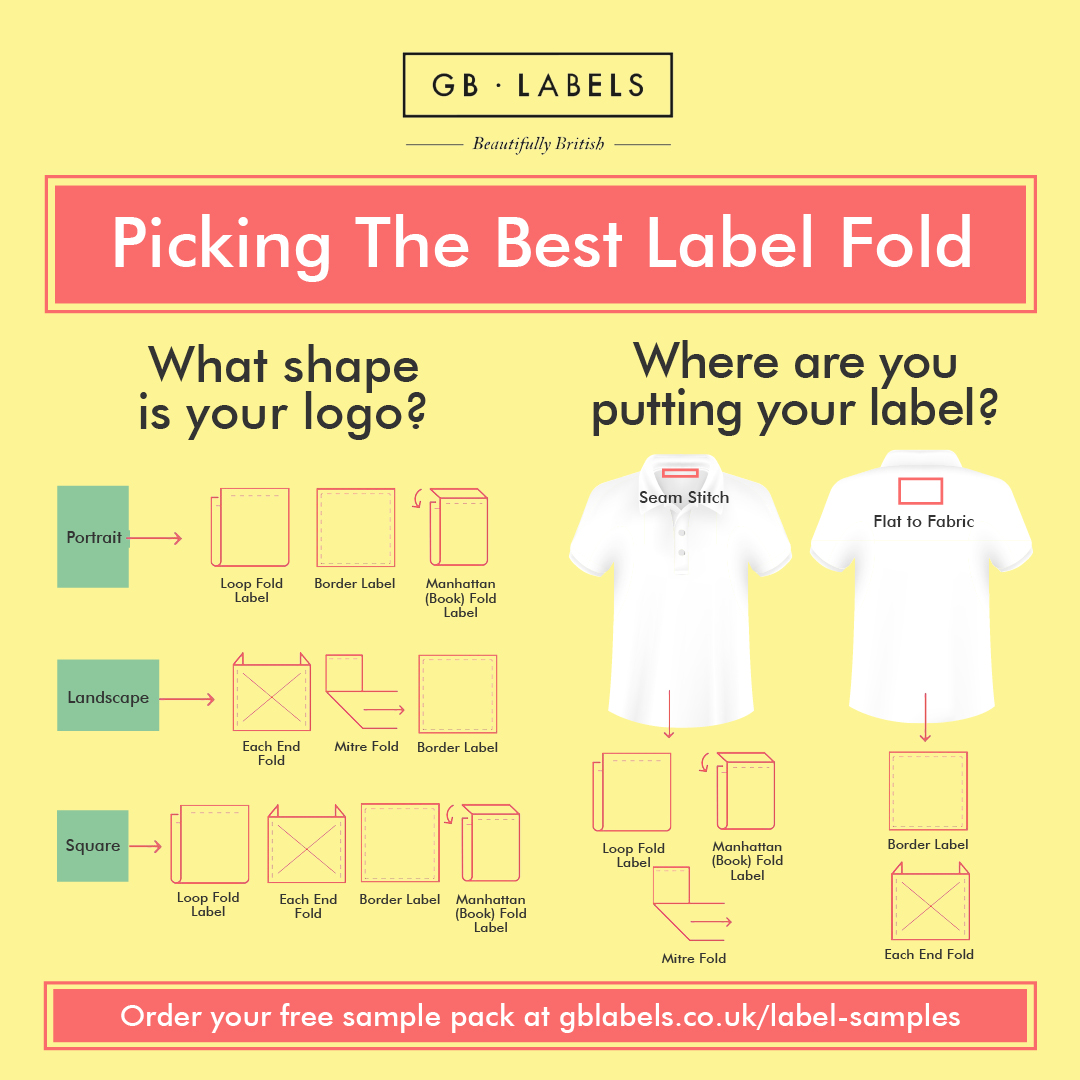
Open the diagram to view it at full size. You can order a sample pack here.
Which fold works for a hem tag?
A hem tag describes the label's position at a garment edge, rather than one fixed fold construction. The label may wrap around the hem, with branding visible outside and another face inside.
Choose the fold to suit the fabric thickness and attachment method. Check where the top edge, seam allowance and lettering will end up when the tag is folded around the garment. Our label types and placement guide explains hem tags in more detail.
How do you measure a folded woven label?
Separate the visible finished size from the full unfolded size. A label with a front and back face needs space for both, plus any turned edges and sewing allowances.
- Mark the area that should remain visible after the label is attached.
- Show the fold lines and which edges will be sewn.
- Keep important text and logos clear of the stitching and hidden folds.
- Check the direction of the artwork on every face.
- Confirm the dimensions on the proof before production.
A paper mock-up can help you check the position and proportions on a garment. A physical label sample then helps you judge the material, edge finish and bulk.
What is the strongest or most comfortable label fold?
Fold type is only part of the decision. Durability and comfort also depend on the material, edge finish, sewing allowance, stitching and position on the garment. Test the intended combination rather than choosing a fold by strength claims alone.
For sewing options, read our illustrated guide to attaching woven labels.
What is the cheapest or fastest label fold?
Price and production time depend on the complete specification, including the artwork, material, size, fold and quantity. Confirm the current quotation and timing for your order instead of relying on a general turnaround figure.
Need help choosing your label fold?
Send us your artwork and a photo or sketch of where the label will sit. Tell us whether the garment is already made, which faces should show and how you plan to sew the label.
Explore our woven clothing labels, order a sample pack or contact GB Labels for help with the fold and layout.
Pete
